
Rats are delicate creatures. They need lots of attention and care. They are very intelligent animals. Their metabolism is very close to humans – which is why they are used in laboratory testing. The rats in the MASS MOCA exhibition are transgenic rats, meaning they have human DNA mixed with their own. So they are kind of our cousins. These rats need to be checked often (frequently each and every day!), and the caretaker must spend time watching them to learn about their needs. Please do not consider the rats just pets, but a creature that co-exists with us. In other words, please treat them with a lot of respect.
Observation:
Observe where the rats like to hang out and what they like to do there. This will help you “enrich” these areas for play, for napping, for eating, for pooping, etc. They will develop a shitting area (their toilet!) which you can help shape if you want to move their poop to a certain area. Eventually they will just use that area primarily to poop in. They need to have lots of food stations and water stations throughout the living space. They also like to scavenge for food as well. They also need toys and hiding places as well, a varied habitat is best with lots of activities. They love to climb, to build nests and to chew on things.
Food:
Rats eat a varied diet. They are omnivores so they eat just about everything.
You need to keep their food bowls filled (check in the morning and at night).
They eat “Royal Rat,” a kibble type food, mixed with “Reggie-
Premiere Rat Food”. We may experiment with their food throughout the
exhibition because I want them to eat more people food. This will be done
gradually so watch for updates on this front. Also give them yogurt treats
whenever you see them (“Kaytee – Yogurt Dips” blueberry
flavor, or yogurt covered raisins) and this way they will learn to love you.
Fresh Water:
Water is probably the most important thing. The rats must only receive bottled water. They can get dehydrated really easily so always make sure they have enough water (and use multiple water bottles throughout the caging unit). The water bottles need to be cleaned out at least once a week – scrub the nozzle where they drink from as bacteria can build up there. And also wash out and cleanse the interior of the bottles too. Only use a kind of “green” cleaning product to clean with. And rinse the bottles out really really carefully once you have washed them so that there is no soap left in them.
Toys:
Rats love paper towels. I give them fresh ones every day (like about half a dozen) and take out some of the old ones if they are really messed up with poop, etc. I use the brown Seventh Generation paper towels that do not have any bleach in them.
They also love soft things. You will be given a series of hand made toys to give them. Just replace them as they are used up. Or make your own!! Just remember they will eat everything you give them so make sure the materials are edible (like use cotton and not poly fabrics). Also wooden toys are good for them to chew on to keep their teeth filed down (their teeth can get ingrown and needs to be watched – that why they need chew toys).
Cleaning:
Rats are incredibly clean animals and cleanliness means a lot to them. So their cages must be kept clean to keep them healthy and happy. It must be cleaned once a week at the least – which means changing the bedding and washing out the cages. These cages will be built so that they can be taken apart in units. The entire cage must be washed down as they will smell bad if not. The bedding used in the cages is the cardboard kind –“CareFresh” is the name of the product. You may use other wood chip products but NEVER use cedar as it can case lung problems for the rats. Maple or pine is ok if you use wood chips.
Sickness and Health:
Rats can have a series of different problems so be observant!
Model HLA-B27 Transgenic Rats
These are albino lab rats, and retired breeders. They had between 3-4 litters
before they came here. They are roughly 10-11 months old (rats generally live
2-3 years at the most). They are white rats with red eyes. Their eyes are
sensitive to light and can be damaged if exposed to too much sunlight or bright
lights. They will probably lose their fur during the course of the exhibition,
and become completely bald. This is normal (although it looks weird and they
can be very pink and wrinkled).
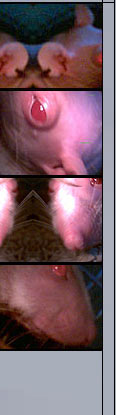
Sample of rat with hairless wrinkled skin:

You should try and play with them as much as you can. This can be done in the cage. Also talk to them all the time. They will learn to love the sound of your voice. Be careful not to spook them, move slowly around them. If you put your hand in the cage you can try and pet them (and should!) but be careful as they might bite if frightened or startled. They need contact, but protect yourself as well, ok? If you do get bitten get a tetnus (sp??) shot from your doctor. You do not have to worry about rabies as they are from a lab and have never had contact with anything that could have given them rabies.
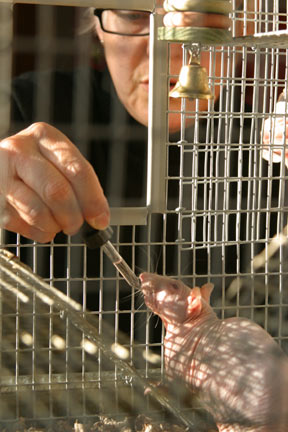
They can loose weight and get sick as a result. So watch that they that they do not get too skinny. You should notice that their food goes down in amount everyday (indications that they have eaten!). Also they should respond to you when you approach them everyday (unless they are sleeping). This will show that they are alert and healthy. Should they not be eating try and administer a “yogurt shake” drink mixed with water and chicken stock to them in a dropper (like an eye dropper) and call the vet.
They sleep a lot and also hide when they do (borrowing under something is their favorite way to sleep). They will wake up late afternoon and start to come out to play. They also will be a bit livelier in the morning. But middle of the day will most likely be nap time.
They can have colds to seizures generated by loud audio sounds (these are called “audiogenic seizures”). When this happens it can look scary but they will be ok. It is like an epileptic fit and their entire bodies can spaz out – they can even flip, or crawl up the sides of the cage and then drop. You can catch them and place them in a safe place, but they also might jerk when you touch them. Don’t be frightened if this happens. It looks really bad, but they can survive it and it happens to this breed of lab rats (it is part of the bad “circuitry” they have been given!). Try and stay calm, and make notes of when this happens and how intensely the attacks are.
When they have fits I begin to administer homeopathy to them. Sometimes they take feedings from a dropper and sometimes you have to hide the homeopathic pill inside a soft treat and give it to them. (To follow will be the protocol for the homeopathy regiment). You should notify the vet if they look “hang dog,” and if they have seizures, although you will be able to deal with them yourself after a bit of training.
If you hear sneezing or if they are unresponsive you also must call
the vet right away. Rats can get sick with viruses and can go downhill really
quickly, and so you must contact help right away if this happens or it could
be fatal. Coughing would also be a suspicious symptom to watch out for.
 |

|
 |
|||
 |
 |
 |
|
||
 |
|
||||
 |
|
||||
 |
|
||||
 |
|
||||
 |
|
||||
 |
|
||||
 |
|
||||
 |
|
||||
 |
|
||||
|
|
|
|
|
|
|